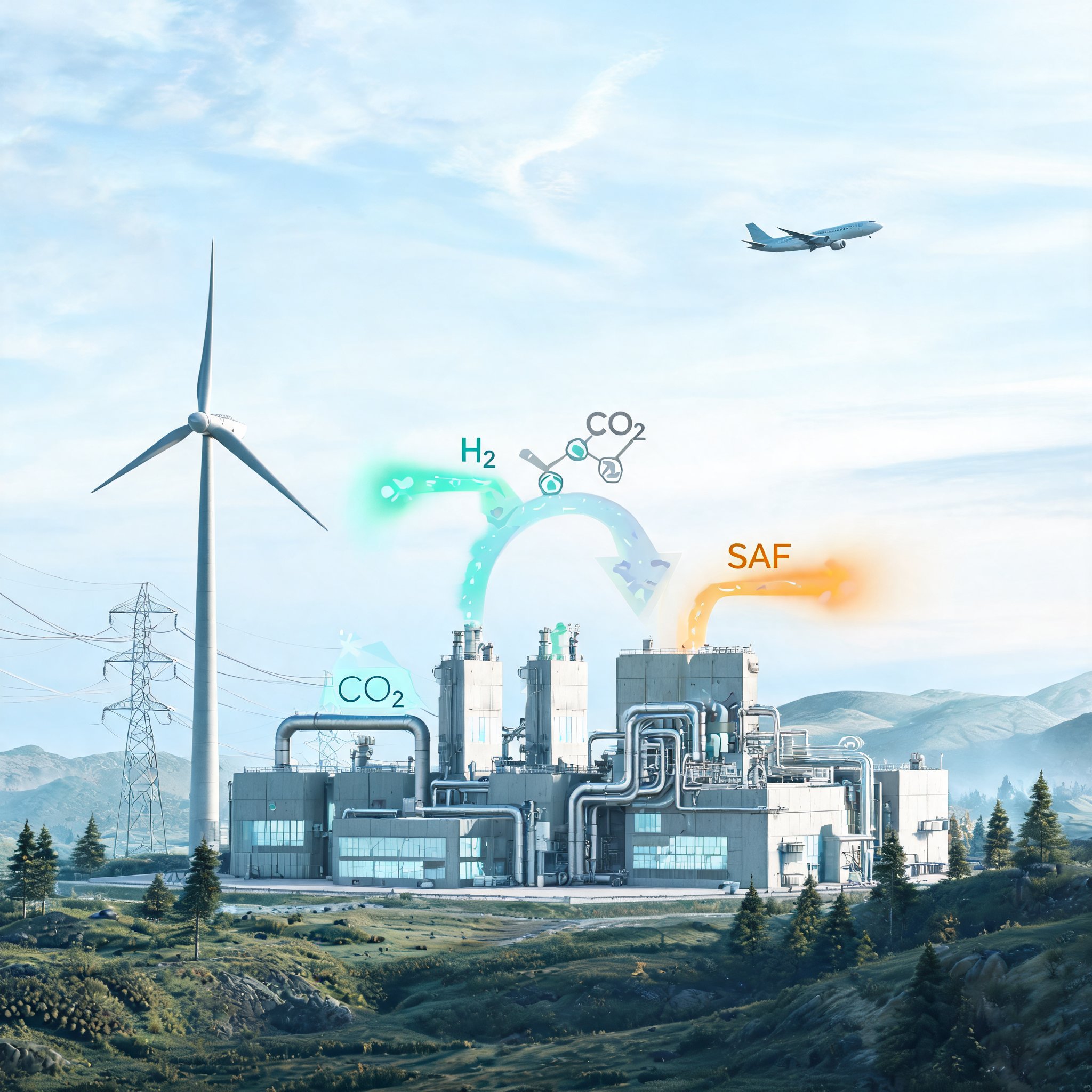
Topsoe A/S, based in Kgs. Lyngby, Denmark, and Sasol Ltd., based in Johannesburg, South Africa, have signed a license and engineering agreement with Alby PtX AB for its planned e-SAF facility in Alby, Sweden. The agreement covers an integrated gas-to-liquid technology package for the project.
The package, known as G2L, combines Topsoe’s eREACT and hydroprocessing technologies with Sasol’s low-temperature Fischer-Tropsch (LTFT) technology. eREACT is intended to enable synthetic gas production. The hydroprocessing technology, together with LTFT, is meant to upgrade synthetic hydrocarbons into aviation fuel and support production of approximately 66,000 metric tons of e-SAF annually.
According to Sasol, the facility will convert renewable hydrogen and captured carbon into sustainable aviation fuel. Under the agreement, Topsoe and Sasol will license the technology and provide the licensor package, technical expertise and capabilities to support development of the facility.
Technology and project rationale
Andreas Schmid, chairman of the board at Alby PtX and executive director at Prime Capital AG in Frankfurt, said Topsoe and Sasol bring an established technology partnership and extensive experience in certified synthetic fuel production. He said the project would put technology proven over decades to work in a new application. Schmid said the strength of the combination lies in how the technologies work together: making efficient use of renewable power and captured carbon while maximizing aviation fuel output. He said this gives Alby PtX a foundation to advance the project and contribute to aviation’s decarbonization and a more resilient European fuel supply.
Yassir Ghiyati, chief commercial officer at Topsoe, said scaling e-SAF production is an important step toward strengthening Europe’s energy resilience, fuel supplies and decarbonizing aviation. He said Topsoe’s gas-to-liquid offering, which combines the company’s advanced technologies with Sasol’s, can support Alby PtX as the project advances to its next stage of development.
Sarushen Pillay, executive vice president for Business Building, Strategy and Technology at Sasol, said the company is bringing decades of experience in Fischer-Tropsch technology to the project. He said Sasol and Topsoe are providing Alby PtX with an integrated technology solution for sustainable aviation fuel production. Through the partnership, the companies are licensing the technology and providing the licensor package, technical expertise and capabilities to support development of the facility, which will convert renewable hydrogen and captured carbon into sustainable aviation fuel. Pillay described Alby PtX as a strong example of how proven technology and collaboration can help advance sustainable aviation fuel projects toward commercial reality and support lower-carbon aviation at scale.
Recent agreements
The Alby PtX agreement follows other recent joint agreements by Topsoe and Sasol, including agreements with HDF Energy S.A. of Bordeaux, France, and Bharat Petroleum Corp. Ltd. of Mumbai, India.