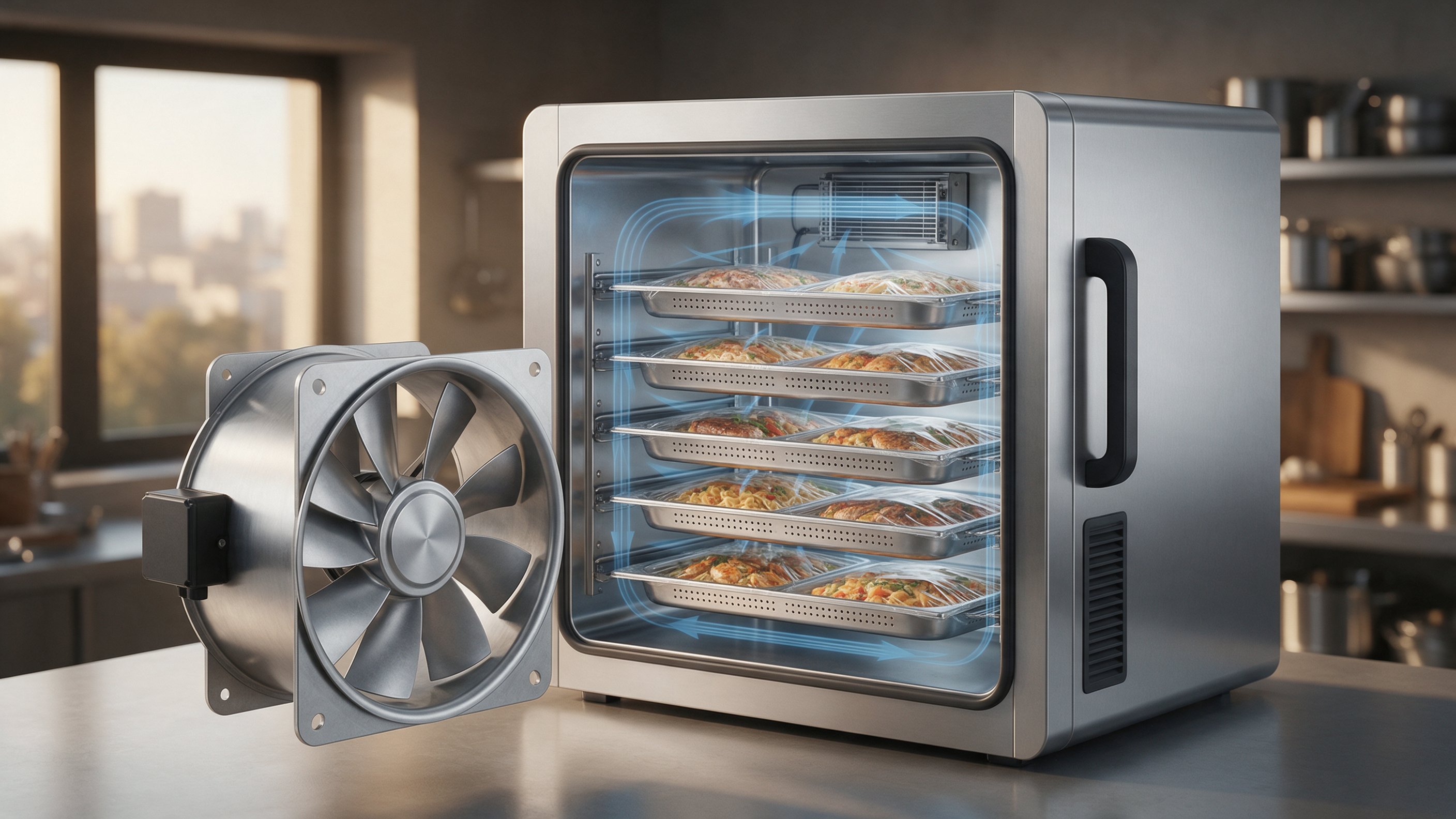
Commercial refrigeration is no longer judged only by how much cold it can produce. Food safety, energy costs and European regulatory pressure are pushing professional kitchens and food plants toward equipment that combines process control, airflow engineering and digital management. In this setting, the article presents blast chillers as more than a specialist kitchen appliance: they are becoming a system-level solution for rapid cooling, quality preservation and more efficient installations.
Why rapid cooling matters
The food-safety case is straightforward. After cooking, food passes through the range of roughly 63°C to 4°C, described in the article as the danger zone, where microorganisms can multiply quickly. HACCP practice therefore focuses on reducing the time food spends in that range. Blast chillers use intensive cold-air circulation to bring food from more than 70°C to below 3°C in as little as 90 minutes. The article links that speed to limits on bacterial growth, longer shelf life and better retention of texture, moisture, aroma and nutritional value, as well as to production planning and waste reduction in hospitals, hotels, catering services and food-processing plants.
Airflow moves to the center of design
The article argues that blast-chiller performance cannot be reduced to the refrigeration circuit, compressor or evaporator. Heat transfer depends on cold air reaching the whole load uniformly; areas of low air velocity or turbulence can leave parts of the product cooling more slowly, with temperature differences that affect safety, cooling time and final quality. That makes the fan a strategic component rather than an accessory. EC motors combine high electrical efficiency with continuous speed control, allowing airflow to be matched to each stage of the cooling process. When combined with biomimetic impeller design and advanced composite materials, the article says, the result is more uniform cold-air distribution and lower energy use. It adds that shortened cooling times or avoiding nominal-rate operation can reduce consumption, and that replacing certain external controllers can free space in the chiller.
The article also identifies secondary operational effects. Better turbulence control can reduce noise and improve working conditions; lower heat generation can support refrigeration-system performance; and lower mechanical stress plus more precise control can extend service life and reduce maintenance. In a market affected by electricity costs, the argument is that energy optimization is not only an environmental concern but a direct factor in installation profitability.
Digital control, traceability and maintenance
Digital management is the second pillar. The article says modern blast chillers can select programs according to food type, monitor temperature through probes and record the process for traceability, which is useful in food-safety audits and HACCP compliance. Open communication protocols such as Modbus allow units to connect to professional-kitchen infrastructure and building management systems. That supports remote monitoring and predictive maintenance: continuous analysis of temperatures, fan speeds, operating hours and energy consumption can reveal deviations before they become failures, reducing maintenance costs and improving availability.
European rules widen the design brief
The regulatory backdrop is also changing. The article notes that EU energy and carbon objectives are driving a revision of rules for energy-related products. The Ecodesign framework is moving beyond energy performance alone to include durability, repairability, digitalization and efficiency at both component and system level. The Ecodesign for Sustainable Products Regulation is described as a turning point, with many measures to be introduced progressively. Although the article does not set out a detailed compliance timetable, it says the 2026 horizon is already influencing decisions by manufacturers and engineering firms. Performance improvements, it adds, will no longer depend only on the refrigeration circuit; motors, fans, heat exchangers and electronic systems will matter equally.
Whole-system efficiency and new roles
This shifts the design objective from maximizing cooling capacity to optimizing energy performance across every component. The article points to collaboration between equipment manufacturers and specialists in ventilation, electronic motors and controls. It cites ZIEHL-ABEGG as an example, saying its EC axial fans for commercial refrigeration and food service combine high-efficiency motors, aerodynamic design, low noise and communication through open protocols for integration into intelligent energy management. The broader point is that a blast chiller's overall efficiency depends on the combined performance of all its parts, and that optimal laminar distribution of cold air can deliver faster, better cooling while reducing the equipment's carbon footprint over its service life.
The article also redefines industry roles. Manufacturers are expected to keep investing in equipment that can meet tighter requirements. Installers, meanwhile, will need more expertise in electronics, connectivity and control systems, because customers are asking not only for refrigeration capacity but for lower operating costs and high reliability. Intelligent components, remote monitoring and predictive maintenance could turn installation professionals into technology advisers across the equipment lifecycle.
What remains open
The analysis is strongest on mechanisms and design priorities, not on quantified outcomes. The article does not provide measured energy savings, payback periods or comparative test data for specific blast chillers, nor does it detail how the 2026 rules will be phased. Its conclusion is therefore a direction of travel rather than a verified performance claim: food safety remains the primary objective, but achieving it will require an integrated approach in which efficiency, digitalization and sustainability are designed together. The next generation of commercial refrigeration, in that view, must produce cold effectively with minimum energy use, greater connectivity and enough flexibility to meet emerging regulatory and environmental demands.